Clarity
Stabilizing perception so decision quality remains high under load.

Philosophy
Most performance breakdowns at scale are misdiagnosed. They’re treated as strategy gaps, communication issues, talent problems, or cultural misalignment.
But at higher levels of responsibility, instability rarely begins with strategy.
It begins with saturation.
The leader’s internal system exceeds its regulation capacity. And when capacity is exceeded, performance destabilizes, regardless of intelligence, experience, or discipline.
You don’t lose capability. You lose stability.
At first, pressure sharpens you. Deadlines energize you. Responsibility expands you. Complexity feels like proof of growth.
Then something shifts.
You are still capable. Still competent. Still respected. But it costs more. More vigilance. More recovery. More internal control.
Delegation feels heavier. Decisions require more energy. Volatility lingers longer in your body.
Nothing is collapsing. But nothing feels effortless anymore either.
This is not burnout. This is capacity saturation.
And most leaders try to solve it with more force. Force works, until it doesn’t.
Most people understand resilience as grit. Withstand the pressure. Take the hit. Bounce back to baseline.
That model works at earlier stages. At scale, returning to baseline is insufficient.
Because the baseline that built your success is not large enough to sustain what you’re now carrying.
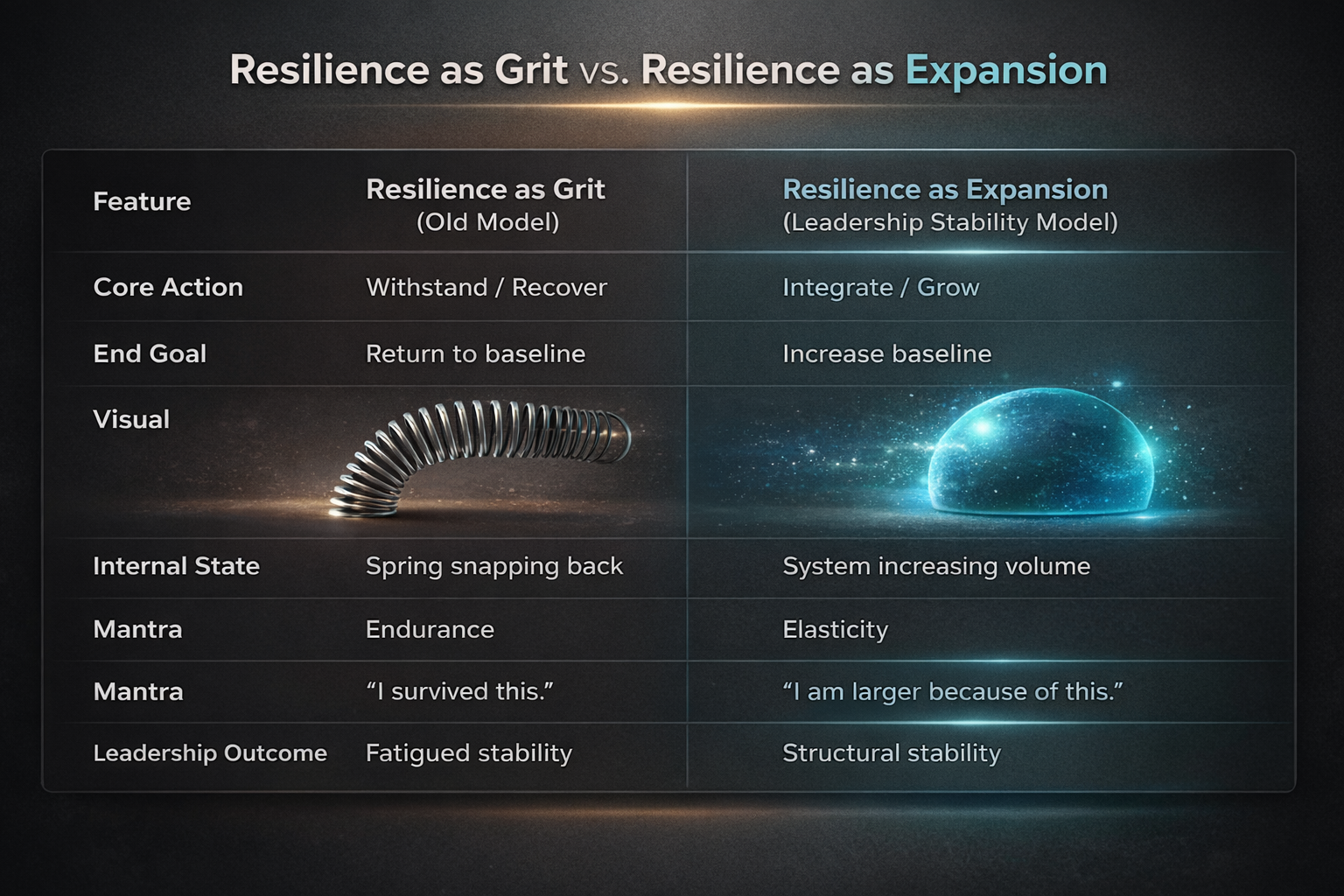
Grit snaps back like a spring. Expansion increases volume.
Under this philosophy, resilience is not toughness. It is dimensional growth.
Not “I survived this.” But “I am larger because of this.”
In biology, this principle is called hormesis, where a stressor strengthens the organism beyond its prior form.
Resilience, properly understood, is expansion. And expansion is what makes stability possible at higher stakes.
If pressure isn’t decreasing, capacity must increase.
The ability to maintain clarity, capacity, and composure under sustained pressure.
Not intensity. Not recovery. Stability.
Because recovery assumes pressure stops. Modern leadership does not.
Decisions remain clean as stakes rise.
Emotional regulation holds during volatility.
Delegation does not trigger contraction.
Recovery accelerates instead of lengthens.
Confidence becomes embodied, not performed.
You don’t just withstand complexity. You metabolize it.
You don’t brace. You regulate.
Stability is not passive. It is built.
The discipline behind it
Neuro-Resilient Leadership installs through three structural pillars.
Stabilizing perception so decision quality remains high under load.
Expanding tolerance for sustained complexity and responsibility.
Maintaining regulation during volatility instead of compensating through control.
First, perception stabilizes. Then, capacity expands. Then, composure holds under stress. Together, they create structural stability, not temporary momentum.
You are not your volatility.
You are not your stress response.
You are not your over-control.
Those are adaptive strategies that built your early success. But what builds momentum is not always what sustains scale.
Leadership at higher levels requires expansion. And expansion requires regulation.
This is not about becoming tougher. It is about becoming vast.
A resilient leader is not hardened. They are elastic. They are structurally stable.
This philosophy is not for early-stage founders seeking motivation.
It is for leaders who have already proven capability.
Post-proof. Pre-freedom.
They have built something real. And privately, they feel: subtle instability, performance fatigue, or the quiet friction between their external success and internal steadiness.
They do not need more tactics. They need coherence.
When coherence returns: execution stabilizes. Delegation becomes clean. Presence deepens. Recovery shortens. Confidence stops feeling performative.
You stop bracing. You start leading.
Leadership Stability is not a trend. It is an operating standard for volatile environments.
In an economy defined by sustained uncertainty, instability at the top is expensive.
Organizations do not break from lack of intelligence. They break from unstable leadership under pressure.
Leadership Stability is trainable. Expansion is measurable.
And when installed, stability becomes the quiet competitive advantage no framework, technology, or AI system can replace.
If pressure isn’t decreasing, capacity must increase. And stability must be built intentionally.
That is the philosophy.